
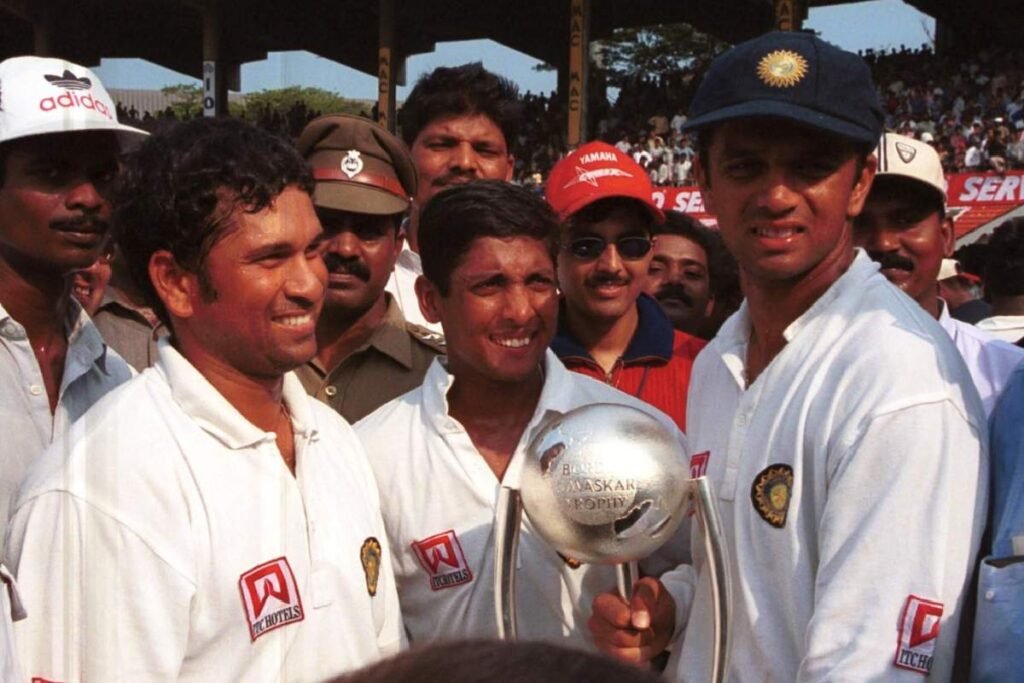
Who Won the 2001 Border Gavaskar Trophy? India defeated Australia 2–1 in the 2001 Border-Gavaskar Trophy, completing one of the greatest comebacks in Test cricket history. What began as a seemingly one-sided contest eventually transformed into one of the most dramatic series the sport has ever witnessed, a contest that tested skill, resilience, and strategic brilliance, ultimately ending with India’s historic triumph over Australia and proving how belief and perseverance can overturn seemingly impossible odds.
Australia arrived in India as the most dominant team in world cricket. Led by captain Steve Waugh, they carried an astonishing streak of 16 consecutive Test victories, and their commanding win in the opening Test at Mumbai, driven by Adam Gilchrist’s electrifying century, seemed to confirm that India faced an uphill battle. Yet, beneath the statistics and the apparent inevitability of defeat, the seeds of one of cricket’s most extraordinary comebacks were quietly being sown, highlighting how preparation, team cohesion, and mental fortitude often play as critical a role as raw talent in defining the outcome of a series.
Australia’s dominance before the 2001 Border-Gavaskar Trophy
ustralia entered the 2001 series as an almost invincible force, and their 1st Test victory in Mumbai seemed to reinforce the perception of inevitability, but India’s team, guided by careful planning, tactical intelligence, and relentless determination, was quietly preparing for a turnaround that would etch itself into cricketing history. With every session, the Indian players demonstrated that resilience, focus, and mental strength could gradually chip away at even the most dominant opposition.
What happened at the 2001 Eden Gardens Test?
The 2nd Test in Eden Gardens remains etched in cricketing memory not merely for its dramatic reversal of fortune, but for the intensity of emotion and sheer brilliance on display, as India, forced to follow on after a daunting first innings deficit, produced a monumental turnaround. VVS Laxman’s majestic 281, a blend of patience, timing, and audacious shot selection, combined with Rahul Dravid’s stoic and unflappable 180, redefined the possibilities of a comeback under extreme pressure, while Harbhajan Singh’s record breaking hat trick added both psychological and practical weight, allowing India to seize a victory that seemed implausible at the start of the match and to rewrite the expectations of the cricketing world.
Why the Kolkata test became one of Cricket’s greatest comebacks
The turning point of the series arrived through a collection of extraordinary individual performances that, when combined, completely changed the direction of the contest and ultimately secured India’s historic victory. VVS Laxman transformed what looked like certain defeat into the beginning of an extraordinary comeback with his elegant and patient 281, while Rahul Dravid’s resilient 180 provided stability and endurance, allowing India to steadily rebuild their position and frustrate the Australian attack. Equally decisive was Harbhajan Singh, whose relentless spin bowling and historic hat trick electrified the Eden Gardens crowd and delivered a crucial psychological advantage, ensuring the Australian batting lineup remained under constant pressure.
Why India Won the 2001 Border Gavaskar Trophy
India’s eventual 2–1 series victory over Australia was not merely the result of individual brilliance but the product of strategic planning, leadership under pressure, and the ability to capitalize on critical moments, as Sourav Ganguly’s captaincy, combined with the exceptional form of VVS Laxman, Rahul Dravid, and Harbhajan Singh, created a synergy that allowed India to overcome a team that many considered unbeatable, proving that determination and execution can outweigh statistical dominance in Test cricket.
Final result of the 2001 Border-Gavaskar Trophy
| Test | Venue | Winner |
|---|---|---|
| 1st Test | Mumbai | Australia |
| 2nd Test | Kolkata | India |
| 3rd Test | Chennai | India |
Who Won the 2001 Border-Gavaskar Trophy? India won the 2001 Border-Gavaskar Trophy 2–1, ending Australia’s 16-match unbeaten streak and solidifying a legendary comeback that continues to be celebrated in cricket history.
Fun Facts from the 2001 Border-Gavaskar Trophy
The atmosphere at Eden Gardens during the Kolkata Test thrilled over 90,000 passionate fans, who turned every session into an emotional spectacle and fueled India’s performance. The series left a lasting impression on many Australian players, including Adam Gilchrist, who later described the dramatic turnaround in Kolkata as one of the most mentally challenging moments of his international career. Only three teams in Test history have won after being forced to follow on, and India 2001 stands among them. The 376-run partnership between VVS Laxman and Rahul Dravid, Harbhajan Singh’s first hat-trick against Australia, and the electrifying support of the crowd all combined to make this series unforgettable.
Laxman’s 281 and Dravid’s 180 formed one of the greatest partnerships in Test history. Learn more about how this Test unfolded in What was the Test of India vs Australia 2001?
Why the 2001 Border-Gavaskar Trophy changed Test Cricket
The 2001 Border-Gavaskar Trophy remains an enduring symbol of how belief, resilience, and strategic insight can overcome even the most formidable opposition. The series highlighted individual talent, mental toughness, teamwork, and the ability to perform under immense pressure, leaving a legacy that continues to inspire cricketers and captivate fans worldwide long after the final ball was bowled, demonstrating that no team, no matter how dominant, is invincible when confronted by determination, skill, and unrelenting spirit.
FAQ: YOU KNOW
What made the Eden Gardens Test so legendary?
India followed on after a huge deficit but turned the match around with Laxman’s 281, Dravid’s 180, and Harbhajan’s hat-trick.
Who were the standout performers for India?
VVS Laxman, Rahul Dravid, and Harbhajan Singh were pivotal in securing the comeback and series victory.
How did Australia perform overall in the series?
Australia won the first Test but lost the second and third, ending their 16-match unbeaten streak.
What was the follow on situation in this Test?
Australia enforced the follow on after India’s first innings score of 171 against Australia’s 445.
Why is this series still significant today?
It represents one of cricket’s greatest comebacks, demonstrating resilience, teamwork, and the unpredictability that makes Test cricket special.