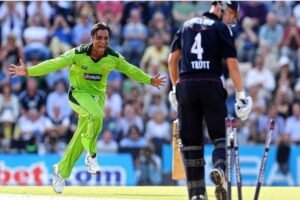

Who was faster Brett Lee or Shoaib Akhtar? Few debates in modern cricket history have generated as much fascination as the question of who was genuinely faster between Shoaib Akhtar and Brett Lee. This comparison is not merely about nostalgia or fan loyalty; rather, it concerns measurable speed, biomechanical efficiency, sustained high velocity spells, and the broader context in which both bowlers operated during the late 1990s and early 2000s. While the record books appear to provide a straightforward numerical answer, a deeper technical evaluation reveals a far more nuanced and intellectually interesting discussion, one that extends beyond a single radar reading and into the realms of consistency, durability, and competitive performance under elite pressure.
At first glance, the debate seems settled: Shoaib Akhtar holds the official record for the fastest delivery in international cricket. However, speed in cricket cannot be reduced to a single isolated moment captured by a speed gun. True pace dominance is measured through repeatability, match impact, biomechanical sustainability, and the ability to maintain extreme velocity across formats and over time. Therefore, to answer the question properly, one must examine peak speed, sustained pace, action mechanics, injury history, and competitive longevity.
Who was faster Brett Lee or Shoaib Akhtar? The Official Record and Its Context
Shoaib Akhtar holds the record for the fastest officially recorded delivery in international cricket, reaching 161.3 km/h during the 2003 World Cup. This speed came from his elite biomechanics and explosive power, and it remains a milestone in cricket history. At the time, radar technology was less standardized than today, but experts consistently recognize this delivery as the fastest authenticated ball in international cricket.
Brett Lee reached a peak of 161.1 km/h in 2005, only slightly below Akhtar’s record. The 0.2 km/h difference is negligible, especially considering that early-2000s speed guns had a margin of error around ±1 km/h. Numerically, Akhtar holds the crown, but the gap between the two bowlers at maximum speed is almost imperceptible.
What sets Akhtar apart is not just a single fast delivery. He crossed the 160 km/h mark multiple times during that tournament, showing that his record was part of repeated extreme pace bursts, not a solitary fluke. Still, peak velocity represents only one aspect of fast bowling, and a deeper analysis requires examining consistency, durability, and match impact.
Who was faster Brett Lee or Shoaib Akhtar? The Difference Between Explosive and Repeatable Speed
Peak speed impresses, but sustaining high pace demands far more from both physiology and biomechanics. Bowling once at 160 km/h requires immense force, yet maintaining 148–152 km/h over several overs demands efficiency, rhythm, and structural durability. In this area, Brett Lee clearly had an advantage.
During the early 2000s, Lee consistently bowled above 145 km/h for long spells without losing rhythm or control. His smooth action allowed him to repeat high speed deliveries while keeping his intensity steady deep into a spell. Akhtar, in contrast, often opened with explosive bursts that spiked dramatically, but maintaining that level for extended periods proved challenging. Injuries and the extreme physical stress of his action frequently interrupted his flow.
This difference matters because cricket rarely hinges on a single delivery. Fast bowlers shape matches through sustained pressure. While Akhtar’s raw bursts were ferociously fast, Lee’s ability to sustain near maximum speeds across formats and seasons suggests he may have been the more consistently fast bowler overall.
Biomechanics and Bowling Action Efficiency Versus Extremity
The mechanics of both bowlers reveal crucial differences in how they generated speed. Shoaib Akhtar employed an extraordinarily long run up combined with explosive front leg bracing and aggressive shoulder rotation, producing tremendous torque through his spine and lower body. This biomechanical strategy allowed him to generate extraordinary velocity but also placed enormous stress on his knees and back, contributing to the injury interruptions that marked his career.
Brett Lee’s action, while equally powerful, was comparatively smoother and more rhythm based. His kinetic chain appeared more synchronized, with efficient energy transfer from lower body to upper body, enabling him to bowl at high speeds without the same degree of visible mechanical strain. This mechanical efficiency likely contributed to his greater durability over time and his ability to maintain pace with slightly less breakdown frequency.
From a biomechanical standpoint, Akhtar may have pushed the physical limits of fast bowling further than Lee, but Lee’s action arguably represented a more sustainable model of elite pace generation.
Performance Under Elite Pressure
Speed alone does not define impact; context amplifies it. During the 2003 global tournament, when the pace race narrative reached its peak, Akhtar’s ability to breach 160 km/h in high pressure matches cemented his reputation as the fastest bowler in the world. The psychological dimension of his bowling, including his aggressive demeanor and theatrical intensity, added to the aura surrounding his pace.
Lee, however, demonstrated his speed in knockout stages and finals across multiple tournaments, often combining high velocity with disciplined line and length. While Akhtar generated fear through intimidation and raw aggression, Lee frequently blended pace with control, making his speed tactically integrated rather than purely explosive.
In other words, Akhtar’s pace was visually terrifying, whereas Lee’s pace was structurally embedded within a more controlled bowling framework.
Longevity and Durability
Career longevity provides another meaningful metric in assessing fast bowlers. Lee played significantly more Test matches and maintained elite pace across a longer period, while Akhtar’s career was intermittently disrupted by injury and suspension. Sustaining speeds above 145 km/h over more than a decade requires not only talent but also conditioning, adaptation, and recovery discipline.
Although Akhtar’s peak may have reached slightly higher, Lee’s ability to remain near the top tier of pace bowlers for a longer uninterrupted span strengthens the argument that he sustained elite speed more consistently over time.
Longevity and Durability
If the question is interpreted narrowly who bowled the single fastest recorded delivery in international cricket the answer is clear: Shoaib Akhtar holds the official record at 161.3 km/h.
However, if the question expands to include sustained high-velocity spells, biomechanical efficiency, durability, and long-term pace consistency, Brett Lee presents a strong and technically compelling case as the more consistently fast bowler across formats and seasons. Therefore, the most intellectually honest conclusion is not simplistic but layered:
Shoaib Akhtar reached the highest verified peak speed. Brett Lee maintained elite pace more consistently over a longer competitive window.
That distinction, rather than fan allegiance, provides the most accurate answer to one of cricket’s most enduring speed debates.
FAQ
Did Brett Lee ever officially bowl faster than Shoaib Akhtar?
No. Shoaib Akhtar holds the official record at 161.3 km/h, while Brett Lee reached 161.1 km/h. Although the difference is extremely small, Akhtar remains the fastest in official records.
Was Shoaib Akhtar consistently faster than Brett Lee?
Not necessarily. While Akhtar produced higher peak speeds and crossed 160 km/h multiple times, Lee was often more consistent at maintaining speeds between 145–150 km/h over longer spells and across formats.
Did speed guns in the early 2000s measure accurately?
Speed measurement technology in the early 2000s was less standardized than today, and minor variations were possible. However, Akhtar’s 161.3 km/h record is widely accepted as the fastest officially recorded delivery in international cricket.
Who had the more sustainable bowling action?
From a biomechanical perspective, Brett Lee’s action was considered more repeatable and efficient, which helped him maintain high pace over a longer career. Akhtar’s explosive action generated extreme speed but placed greater stress on his body.
If both were at their peak on the same day, who would likely be faster?
At absolute peak intensity, Shoaib Akhtar would likely produce the higher single delivery speed. However, over a full spell of 6–8 overs, Brett Lee might maintain higher average pace due to greater rhythm and endurance.